
Open-source LLM tracing with application-level context.
Start FreeSimple Setup
Deploy in minutes
Global Access
Use from anywhere
Expert Support
Chat, email, and consulting available
Langfuse is a strong open-source LLM observability platform. Good prompt management, cost tracking, evaluation features, and a growing community. We respect the open-source commitment. Langfuse was acquired by ClickHouse (announced 2026-01-16). The core stays MIT-licensed (the ee/, web/src/ee/ and worker/src/ee/ directories are under a separate enterprise license) and self-hosting stays first-class. Langfuse's own published roadmap keeps the product on LLM and agent engineering: gateway, proactive issue detection over traces, evaluations and experiments, scale and enterprise controls. No service topology, no infrastructure monitoring. Note the parent does sell general observability separately as ClickStack, but that is a different product with a different deployment, and Langfuse is not it. So the scope split below holds. (source, verified 2026-08-18). This page is an honest look at where DeepCube takes a different approach, where Langfuse excels, and how you can evaluate both.
DeepCube is the product; spatial observability is the category. We are not an APM company, we are a spatial observability company. The capabilities below (application-level correlation, service topology, cross-signal analysis) are how spatial observability un-compresses the high-dimensional reality of your system instead of flattening it to dashboards.
Open standards. Application-level context. AI-powered diagnosis.
Open-Source LLM Tracing Without the Full Picture
Great prompt tracking. No application-level correlation.
- MIT-licensed core (the /ee enterprise folders have separate terms) with a solid self-hosting story. Prompt management, cost tracking, and evaluation are well-designed for LLM-specific workflows. (source: github.com/langfuse/langfuse LICENSE, verified 2026-08-18)
- But LLM traces without application context tell an incomplete story. When your generative AI feature slows down, is it the model provider, the retrieval pipeline, or the application running your embedding service?
- Langfuse sees the LLM calls. It does not see the application underneath, the service topology around them, or the cross-signal correlations that reveal root cause.

Same open philosophy. Application-level scope.

Open Philosophy, Application-Level Scope
OpenTelemetry-native. Application monitoring included. AI diagnosis built in.
- Built exclusively on OpenTelemetry with no proprietary agents. DeepCube shares Langfuse's commitment to open standards.
- 3D spatial topology: See your LLM services alongside the APIs, databases, and application they depend on.
- When something breaks, Tessa diagnoses across all layers and proposes the fix. Application-level correlation that Langfuse does not provide.
Managed spatial observability. Zero self-hosting burden.
Architecture: How We Differ
Managed spatial observability vs self-hosted LLM tracing.
Langfuse gives you open-source LLM tracing that you host and operate. DeepCube gives you managed spatial observability with dependency correlation that reveals whether your LLM issue is actually an application dependency issue.
For teams that want full control over their LLM tracing data, Langfuse's self-hosted option is a real differentiator. For teams that want application-level correlation without the operational burden, DeepCube delivers.
| Aspect | DeepCube | Langfuse |
|---|---|---|
| Scope | Spatial observability: application + LLM telemetry un-compressed into one view | LLM observability. Langfuse's own data-model doc tells you to send infrastructure monitoring to Datadog alongside it (source, roadmap, verified 2026-08-18) |
| Open Source | OpenTelemetry-native (open standard instrumentation) | MIT-licensed core; /ee enterprise folders have separate terms (source: github.com/langfuse/langfuse LICENSE, verified 2026-08-18) |
| Deployment | Managed SaaS (zero operational burden) | Langfuse Cloud, self-hosted Open Source, or Self-Hosted Enterprise bundled with ClickHouse Cloud, BYOC, or Private (Langfuse fees additive to the ClickHouse plan) (source, verified 2026-08-18) |
| Visualization | 3D spatial topology + web dashboards | Trace and agent graph views, custom dashboards, full-text search, Pulse cost/latency strip (v4, 2026-08-17) |
| Service Topology | Auto-discovered 3D service map | No service/infrastructure topology. No topology row exists anywhere in the Langfuse feature matrix (source, data model, verified 2026-08-18) |
| Application Metrics | Application metrics via OTel correlated with traces | LLM application-level metrics (latency, tokens, cost); no service/infrastructure topology (source: langfuse.com/docs/observability/overview, verified 2026-08-18) |
| Prompt Management | Via codebase workspace (Tessa) | Prompt versioning, management UI (source: langfuse.com/docs/observability/overview, verified 2026-08-18) |
| Cost Tracking | Token and cost telemetry via OTel | Built-in LLM cost tracking (source: langfuse.com/docs/observability/overview, verified 2026-08-18) |
| Cross-Signal Correlation | Traces + metrics + logs unified in spatial view | LLM traces only |
Tessa fixes code. You review it. You own it.
| Capability | Tessa (DeepCube) | Langfuse |
|---|---|---|
| AI Diagnosis | Cross-signal anomaly detection with spatial context | Langfuse Assistant, an in-app agent, is on every Langfuse Cloud tier (public beta since 2026-06-19, not available self-hosted). It answers questions about traces, observations, sessions and metrics, and takes actions in Langfuse with per-action approval. It runs on the authenticated MCP server, which exposes read and write tools across prompts, observations, scores, datasets, evaluators and dashboards. Everything it reasons over is LLM-trace data; there is no application or infrastructure signal underneath it. (source, verified 2026-08-18) |
| Codebase Access | Full workspace: read, search, rename, modify | No first-party access to your repository. Langfuse ships an Agent Skill and a CLI so your own coding agent (Claude Code, Cursor, Codex) can instrument code and migrate prompts, but the agent and the repo context are yours, not theirs (source, verified 2026-08-18) |
| Code Fixes | Available on every plan. Tessa traces the issue to the source file in your connected workspace and proposes the change. You review, you approve, you commit. | The Langfuse skill runs annotate / analyze / revise loops that end in a revised prompt. No first-party code-fix product. (source: langfuse.com/blog 2026-02-16, verified 2026-08-18) |
| Root Cause Analysis | Application-level: LLM + app + dependencies | LLM trace-level only |
| Accountability Model | Human on the loop | Assistant proposes, you approve, inside Langfuse. No approval path that reaches your code |
AI: Tessa vs Manual Investigation
Human on the loop.
Tessa accesses your connected codebase workspace, diagnoses from 3D topology, and makes the fix. You review, you own it. When your LLM costs spike unexpectedly, Tessa does not just show you the token counts. It correlates the cost increase with traffic patterns, identifies which service is generating excessive LLM calls, traces it to the code path, and proposes the fix.
Langfuse gives you cost dashboards, threshold monitors, and an assistant that can answer "what did I spend this week, by model." What none of them can tell you is which service called the model that often, or why. Tessa closes the gap between "I see the cost spike" and "the fix is ready for review."
One platform for LLM + application monitoring. One price. Zero ops.
Pricing: Managed Spatial Observability vs Self-Hosted LLM-Only
The true cost of self-hosting.
- One platform, not three: DeepCube includes LLM observability, application monitoring, and AI diagnosis. Langfuse covers the LLM layer only.
- No operational burden: DeepCube is a managed service. No infrastructure to provision, no upgrades to manage, no "monitoring the monitor."
- Predictable pricing: Nodes x tier price = monthly cost. No per-event or per-observation charges.
- AI included: Tessa is part of every DeepCube plan at no extra charge. There is no AI seat, no AI add-on, and no per-query AI meter to budget for. Every plan can run every Tessa skill, including Code Fix and root-cause analysis; higher plans put a more capable model behind them.
| Capability | DeepCube | Langfuse |
|---|---|---|
| LLM Observability | Included | Self-hosted free / Cloud: Hobby free, Core $29/mo, Pro $199/mo, Enterprise $2,499/mo (source: langfuse.com/pricing, verified 2026-08-16) |
| Application Monitoring | Included | Not available (requires separate tool) |
| Application / Distributed Tracing | Included, correlated with service topology | Ingests OTLP traces over HTTP (JSON and protobuf; gRPC not supported). No service topology beneath them to correlate against (source, verified 2026-08-18) |
| AI Assistant | Included (Tessa) | Langfuse Assistant, an in-app agent (public beta 2026-06-19), on all Cloud plans but NOT self-hosted. Plus an authenticated MCP server with read and write tools. No codebase access, no code-fix flow (source, verified 2026-08-18) |
| Operational Burden | Zero (managed SaaS) | Self-hosted: upgrades, scaling, backups, monitoring the monitor |
| Spatial Observability Total | $45/node/month (Analyze) | Langfuse + APM tool + ops cost |
DeepCube pricing from immersivefusion.com/pricing. Langfuse pricing from langfuse.com/pricing. Verify current pricing before purchase. All prices USD.
OpenTelemetry bridges both worlds
Already Using Langfuse? Add Application Context.
Keep Langfuse for prompts. Add DeepCube for application-level depth.
- Keep Langfuse for prompts: If you rely on Langfuse's prompt management, keep it running. DeepCube adds the spatial observability layer.
- Eliminate self-hosting burden: Move your observability to a managed service. Focus your team on building, not operating monitoring infrastructure.
- Dual-destination: Langfuse supports OTel trace ingestion (OTLP over HTTP; gRPC not yet supported). Your OTel Collector fans out telemetry to both DeepCube and Langfuse simultaneously. (source: langfuse.com/integrations/native/opentelemetry, verified 2026-08-18)
- Exit guarantee: If DeepCube is not right for you, change one endpoint URL. Your instrumentation stays exactly the same.
Dual-Destination Collector Config
exporters:
  otlp/deepcube:
    endpoint: "https://otlp.deepcube.ai"
    headers:
      API-Key: "YOUR-API-KEY"
  otlphttp/langfuse:
    endpoint: "your-langfuse-instance/api/public/otel"

service:
  pipelines:
    traces:
      exporters: [otlp/deepcube, otlphttp/langfuse]
    metrics:
      exporters: [otlp/deepcube]
Standard OTel Collector config. LLM traces go to both. Application metrics go to DeepCube.
Ready for LLM Tracing with Application Context?
Start free with DeepCube. Your OTel instrumentation just works.
Start FreeCompare DeepCube against other tools | LLM observability comparison | Enter a live system
Always-On Demo
Running right now, unscripted, and nobody started it for you. It is one of our live grids, not a customer's system, but nothing about it is staged: we point chaos at it and hunt the gap live. Watch for a minute, send it to whoever is on call with you, or scroll on and go play with one yourself.
That's our side of it. Now go try the alternative.
See what our customers are saying
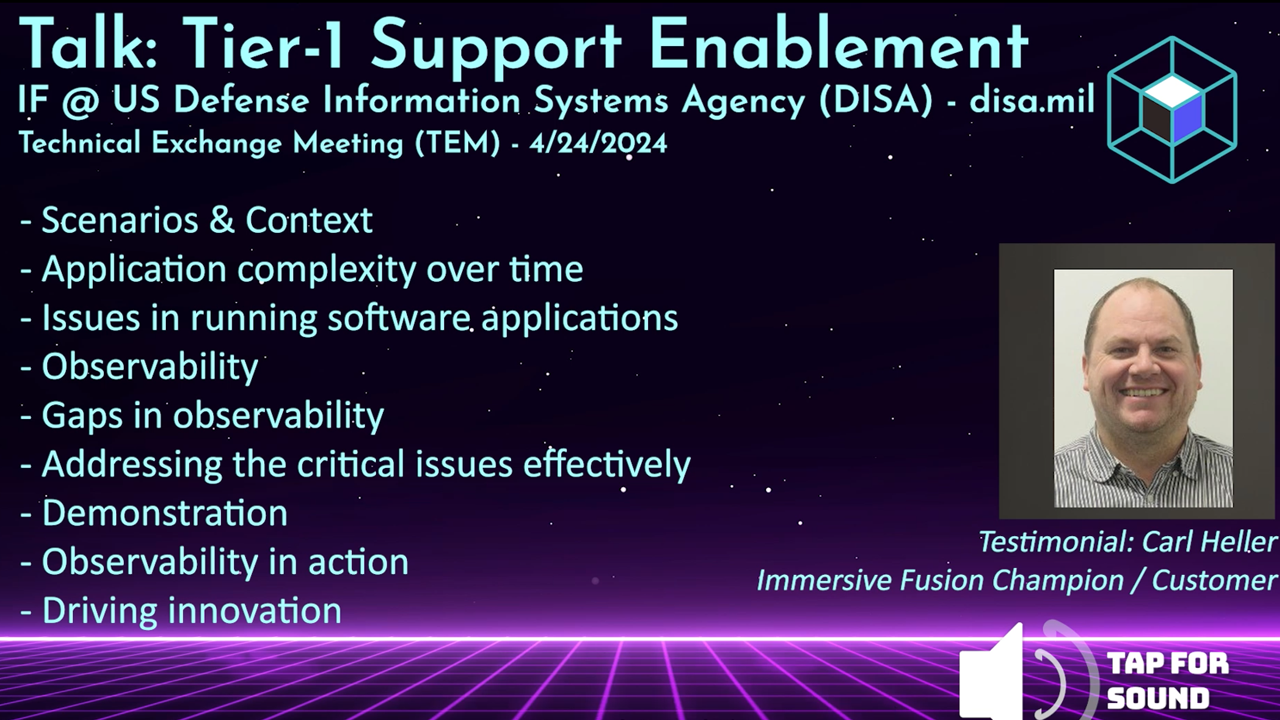
Testimonial from the US Defense Information Systems Agency (DISA/disa.mil) talkWatch the testimonial from the DISA TEM talk | Request the full DISA TEM talk video
The Better Way to Monitor and Manage Your Software
Streamlined Setup
Simple integration
Cloud-native and open source friendly
Rapid Root Cause Analysis
Intuitive tooling
Find answers in a single glance. Know the health of your application
AI Powered
AI Assistant by your side
Unlock the power of AI for assistance and resolution
Intuitive Solutions
Conventional and Immersive
Expert tools for every user:
DevOps, SRE, Infra, Education