
All the openness. None of the assembly.
Start FreeSimple Setup
Deploy in minutes
Global Access
Use from anywhere
Expert Support
Chat, email, and consulting available
Grafana Labs was named a Leader in the 2026 Gartner Magic Quadrant for Observability Platforms, its third consecutive year, and placed furthest for Completeness of Vision for the second year running (source, verified 2026-08-18), with 76,000+ GitHub stars (source, verified 2026-08-18) and the most respected open-source observability ecosystem in the industry. We respect that. This page is an honest look at where DeepCube takes a different approach, where Grafana excels, and how you can evaluate both with the same production data.
DeepCube is the product; spatial observability is the category. We are not an APM company, we are a spatial observability company.
Six tools. Six configurations. One observability goal.
Source: grafana.com/oss (Grafana, Loki, Tempo, Mimir, Pyroscope, Alloy shipped as separate projects)
The Assembly Required Problem
Six tools. Six configurations. One observability goal.
- Loki, Tempo, Mimir, Pyroscope, Alloy, Grafana: Grafana ships these as six separate open-source projects, each with its own repository and release train. Self-host and assembling them into one platform is your job.
- Assembly tax: configuration, upgrades, scaling, cross-signal correlation, and on-call for the monitoring system itself.
- Platform engineering bandwidth: for teams that need to ship features, not manage observability infrastructure, the assembly tax is real.
- Self-hosting also reduces the AI, and Grafana says so: "Core chat, dashboarding, querying, and navigation workflows remain available, while Grafana Cloud-dependent features such as investigations, infrastructure memory, and Grafana Cloud MCP connections are hidden" (source, verified 2026-08-19). The open-source path and the full Assistant are not the same product.
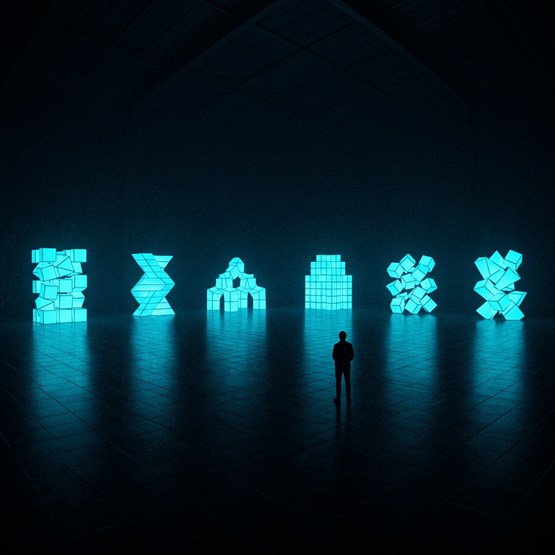
All the openness. Zero assembly required.
What If It Came Assembled?
One platform. Fully managed. Still OTel-native.
- Same commitment to open standards: no proprietary agents, no vendor lock-in. Your OTel instrumentation works with any compatible backend.
- Single, managed platform: traces, metrics, logs, AI, and 3D topology in one product, not six tools you wire together.
- Capabilities dashboards cannot deliver: spatial topology and an AI assistant that fixes code.
One platform. Not six tools wired together.
Architecture: How We Differ
Unified platform vs composable stack.
DeepCube and Grafana share the same commitment to open standards and OpenTelemetry. The difference is what happens after data ingestion. Grafana gives you the best dashboards in the industry. DeepCube gives you a 3D spatial environment where your services, relationships, and telemetry live together, plus an AI assistant that can diagnose issues and fix your code.
Grafana Cloud is fully managed, and we will not pretend otherwise. The assembly does not disappear, it moves to the invoice: Grafana Cloud is sold as 17 separately priced product lines, each with its own meter and its own free-tier limit, and you decide which ones to turn on (source, verified 2026-08-19). Each meter carries its own independent free limit, for example 50 GB of logs per month, 2,232 Application Observability host hours, 3 active visualization users and 3 active AI users, so the free tiers do not pool. DeepCube is one platform at one per-node price, and there is nothing to select.
| Aspect | DeepCube | Grafana |
|---|---|---|
| Platform Model | Unified managed platform | LGTM stack (Loki + Grafana + Tempo + Mimir + Pyroscope + Alloy) |
| Instrumentation | Standard OpenTelemetry SDKs only | OpenTelemetry-native (Alloy, plus Beyla, now Grafana's distribution of upstream OpenTelemetry eBPF Instrumentation) |
| Visualization | 3D spatial topology | 2D dashboards (industry-leading flexibility) |
| Vendor Lock-in | None. Change one endpoint URL to leave. | None. Open-source components, standard APIs. |
| Operational Burden | Fully managed SaaS | Self-managed (OSS) or Grafana Cloud (managed) |
| Community | Growing | 76,000+ GitHub stars, massive ecosystem (source, verified 2026-08-18) |
Tessa fixes code. You review it. You own it.
| Capability | Tessa (DeepCube) | Grafana Assistant |
|---|---|---|
| Codebase Access | Full workspace: read, search, rename, modify | Indirect, and Grafana describes both surfaces that way. gcx: "gcx is a single CLI that allows you and your AI coding agent structured access to both Grafana (dashboards, folders, alert rules, data sources) and Grafana Cloud products" (source, verified 2026-08-19). The MCP server: "The Grafana Cloud MCP server is a remotely hosted Model Context Protocol (MCP) server that lets external AI agents connect directly to your Grafana Cloud data" (source, verified 2026-08-19). Both point outward at an agent you already own (GA 2026-07-28, source, verified 2026-08-18) |
| Production Context | 3D topology + traces + metrics | Metrics, logs, traces, and profiles across Grafana Cloud, with cross-signal correlation and hypothesis testing via Assistant Investigations (GA 2026-07-29) (source, verified 2026-08-19). Grafana defines the deliverable itself: an investigation "forms hypotheses, dispatches sub-agents to prove or disprove them against your telemetry, and produces a structured report with findings, supporting evidence, and recommended next steps" (pricing FAQ, verified 2026-08-19) |
| Code Fixes | Available on every plan. Tessa traces the issue to the source file in your connected workspace and proposes the change. You review, you approve, you commit. | No first-party code-fix flow, and this one rests on Grafana's own complete enumeration rather than on our search. Their self-managed capability list reads, in full: "Chat and prompt-based assistance / Dashboard creation and editing / Query generation and explanation / Navigation across Grafana resources / Rules, quickstarts, and skills / MCP server integrations" (source, verified 2026-08-19). Assistant Skills (GA 2026-03-17) plus auto-approve let users build runbooks that connect to external tools; Grafana's own example is "raising a PR in GitHub or GitLab" via a user-configured pipeline calling GitHub, not an out-of-the-box code-writing agent (source, verified 2026-08-18) |
| Pricing | Included in the price of every plan. No AI seat, no AI add-on, no per-query AI meter. Model quality scales with the plan. | $20.00/active AI user/month at 1-25 users, $18.25 at 26-50, $17.00 at 51+, each seat including 40M tokens with overage at $2 per 1M; Enterprise is custom with a "Minimum commit of $25,000 per year". Note what counts as a seat: "Connecting through the Cloud MCP server also counts as active use", so pointing your own coding agent at Grafana bills an AI user (source, verified 2026-08-19) |
| Spatial Context | 3D topology-aware diagnosis | Grafana Cloud Knowledge Graph "automatically discovers your services, infrastructure, and their relationships from telemetry data" and renders an entity graph of dependencies plus an RCA workbench. It is a 2D dependency graph, not a spatial view you can move through (source, verified 2026-08-19) |
| Accountability | Human on the loop | The terminal deliverable is a report, by Grafana's own definition: an investigation "produces a structured report with findings, supporting evidence, and recommended next steps" (pricing FAQ, verified 2026-08-19). Grafana Assistant can save a dashboard; it does not touch your source (source, verified 2026-08-18) |
AI: Tessa vs Grafana Assistant
Human on the loop.
Tessa connects the telemetry of the environment you are viewing to your connected codebase. Add your repositories as workspaces, and Tessa traces a production issue from the 3D topology straight to the source file, then makes the fix.
Your code stays in your workspace. You review the changes. You commit when ready. Tessa does the work; you own the outcome.
Grafana's equivalent surface holds a different set of things. "Grafana Assistant Workspace is a full-page Assistant experience", and its context picker takes "data sources, labels, metrics, dashboards, entities, and skills" (source, verified 2026-08-19). A repository is not on that list. The one Grafana surface that did reach local files is being retired: "Grafana Assistant CLI is deprecated and will be removed in a future release. Use gcx instead", and its file reach was read-only by design, "Run the tunnel so Assistant can read local project files and, optionally, run approved shell commands on your machine" (source, verified 2026-08-19).
Grafana Assistant helps you write queries, understand anomalies, and investigate incidents within the Grafana dashboard. Valuable for teams who live in Grafana, and Grafana scopes it themselves: "Grafana Assistant brings a purpose-built LLM to Grafana so operators, developers, and SREs can troubleshoot issues, manage dashboards, and answer product questions in minutes" (source, verified 2026-08-19). It does reach a codebase, through the gcx CLI and an MCP server, but Grafana's own pricing FAQ puts the code reasoning on your side of the line: when your own coding agent uses gcx or the Cloud MCP server to query Grafana, "the reasoning happens in your agent's model, and no Grafana AI tokens are consumed" (source, verified 2026-08-19). So when the investigation is done you still context-switch to your IDE to make the fix. On Cloud Pro it costs $20/active AI user/month on top of your existing Grafana costs, with the first 3 users free, and it is included on Grafana Cloud's free plan. Tessa is in the price of every DeepCube plan with no AI seat and no per-user AI charge, and goes from diagnosis to code fix in one conversation.
One price. Everything included.
Pricing: The Full Picture
Scenario: 40 nodes, 10 engineers.
Grafana Cloud's pricing appears transparent, but the multi-dimensional billing model (per-signal, per-user, per-feature) adds up. Here is what a production deployment looks like.
- What the premium buys: In this scenario DeepCube ($1,575) runs about 24% above Grafana Cloud Pro ($1,267), and that gap buys a different class of product: 3D spatial topology, AI code fixes, and a unified platform in one per-node price, versus dashboards plus separately-billed tools. We show the full math below so you can judge the trade for yourself.
- No per-user fees: DeepCube's platform and its built-in AI assistant are priced per node, not per user. Grafana charges $8/user for visualization and $20/user for AI separately, each with the first 3 active users free (source, verified 2026-08-19).
- Predictable billing: DeepCube's per-node pricing means your bill does not fluctuate with data volume. Grafana Cloud bills per GB across logs, traces, and profiles.
- No operational burden: Self-hosted Grafana is free to download, not free to operate. DeepCube is fully managed with the same OTel portability.
- A billing cliff you should price in now: Grafana states that "Until October 1, 2026, investigations don't count toward your token allowances and aren't billed". After that date investigations bill at $2 per 1M tokens, so a 2026 evaluation understates the 2027 bill (source, verified 2026-08-19).
- Assistant and Investigations are separate purchases: "Assistant and Assistant Investigations are separate products with their own pricing pages" (source, verified 2026-08-19).
- Connecting your own agent bills a seat: "Connecting through the Cloud MCP server also counts as active use", so the integration that keeps the reasoning in your model still consumes a $20 AI user (source, verified 2026-08-19).
| Line Item | DeepCube | Grafana Cloud Pro |
|---|---|---|
| Platform Fee | Included | $19/month (source, verified 2026-08-19) |
| Application Observability (40 hosts) | Included | $18/host/mo x 40 = $720 for customers grandfathered before 2026-02-13. New customers since that date are billed $0.025/host-hr with telemetry charged separately and no included credits, so this line is the grandfathered rate and understates a new customer's bill (source, verified 2026-08-19) |
| Logs (500 GB/mo) | Included | $0.55/GB x 450 GB (after free 50 GB) = $248 (source, verified 2026-08-19) |
| Visualization (10 users) | Per node, not per user | $8.00/active user/mo at 1-25 users ($7.25 at 26-50, $6.80 at 51+), first 3 free, x 7 billable = $56 (source, verified 2026-08-19) |
| AI Assistant (10 users) | Included (Tessa) | $20.00/active AI user/mo at 1-25 users, first 3 free, x 7 billable = $140 (source, verified 2026-08-19) |
| Estimated Monthly Total | $1,575 (Analyze) | $1,267+ (varies with data volume) |
Grafana Cloud pricing based on Pro tier rates from grafana.com/pricing, verified as of 2026-08-19. Actual costs vary by data volume and active users. Self-hosted Grafana is free but excludes operational costs. DeepCube pricing from immersivefusion.com/pricing. All prices USD. Logs billed as a 3-part composite: $0.05/GB process + $0.40/GB write + $0.10/GB retain = $0.55/GB total.
You don't have to rip and replace
Run Both. Migrate Gradually.
Same telemetry, two destinations, zero re-instrumentation.
- Dual-destination: Your OTel Collector fans out telemetry to both DeepCube and Grafana simultaneously.
- Both platforms are OTel-native: migration is straightforward. Add an exporter, see your data in DeepCube's 3D topology, and decide which experience your team prefers.
- Keep your Grafana dashboards: DeepCube adds spatial topology and AI on top. You do not have to abandon existing dashboards.
- Exit guarantee: If DeepCube is not right for you, change one endpoint URL. Your instrumentation stays exactly the same.
Dual-Destination Collector Config
exporters:
  otlp/deepcube:
    endpoint: "https://otlp.deepcube.ai"
    headers:
      API-Key: "YOUR-API-KEY"
  otlp/grafana:
    endpoint: "otlp-gateway-prod-us-central-0.grafana.net:443"
    headers:
      Authorization: "Basic ${GRAFANA_CLOUD_TOKEN}"

service:
  pipelines:
    traces:
      exporters: [otlp/deepcube, otlp/grafana]
    metrics:
      exporters: [otlp/deepcube, otlp/grafana]
Standard OTel Collector config. Same telemetry, two destinations.
Ready to See the Difference?
Start free with DeepCube. Your OTel instrumentation just works.
Start FreeAlways-On Demo
Running right now, unscripted, and nobody started it for you. It is one of our live grids, not a customer's system, but nothing about it is staged: we point chaos at it and hunt the gap live. Watch for a minute, send it to whoever is on call with you, or scroll on and go play with one yourself.
That's our side of it. Now go try the alternative.
See what our customers are saying
Testimonial from the US Defense Information Systems Agency (DISA/disa.mil) talkWatch the testimonial from the DISA TEM talk | Request the full DISA TEM talk video
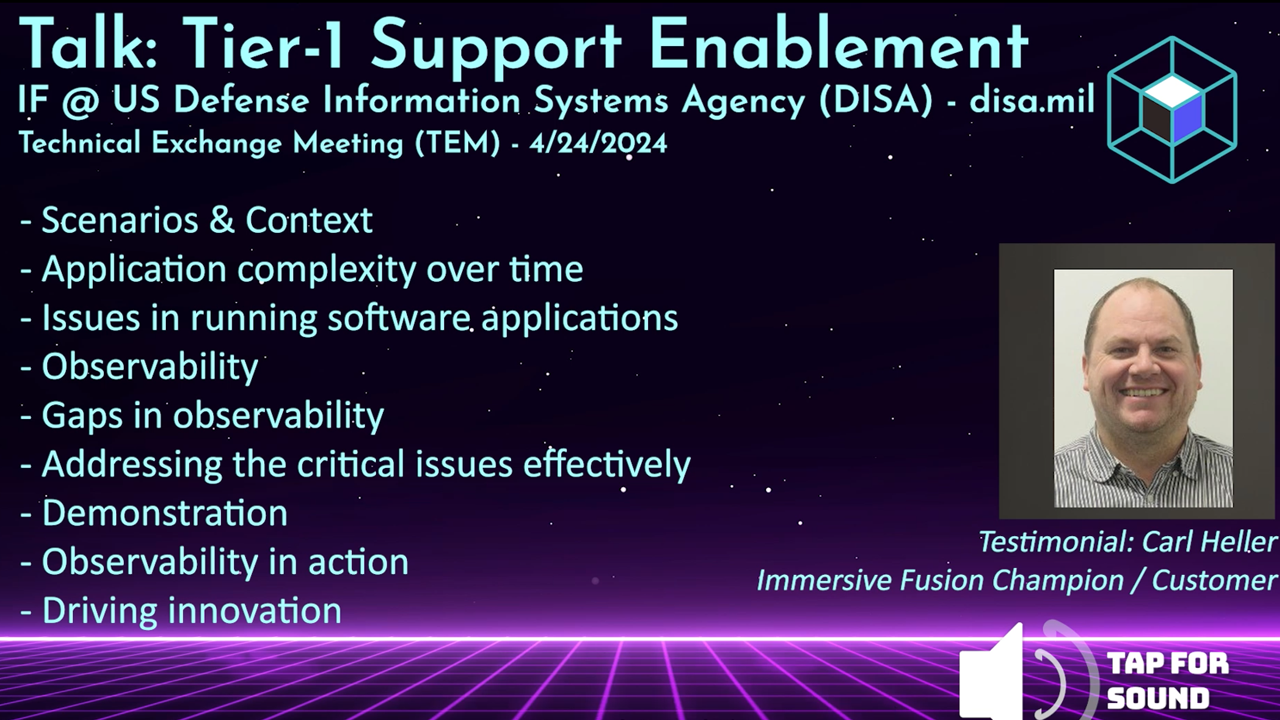
The Better Way to Monitor and Manage Your Software
Streamlined Setup
Simple integration
Cloud-native and open source friendly
Rapid Root Cause Analysis
Intuitive tooling
Find answers in a single glance. Know the health of your application
AI Powered
AI Assistant by your side
Unlock the power of AI for assistance and resolution
Intuitive Solutions
Conventional and Immersive
Expert tools for every user:
DevOps, SRE, Infra, Education